The IEQ model is an assessment framework built by this project to show both sides of your abilities: cognitive intelligence (IQ) and emotional intelligence (EQ). This page explains how scores are calculated, how the 16 types are assigned, and what the model cannot do.
Theoretical foundations
The IQ side is based on the Cattell–Horn–Carroll (CHC) model, a widely used framework for cognitive abilities in psychometrics. CHC describes intelligence in layers: a general factor at the top, with broad abilities underneath such as fluid intelligence (Gf), crystallized intelligence (Gc), visual processing (Gv) and quantitative knowledge (Gq). The project selected five abilities that can be measured with online multiple-choice questions.
The EQ side combines two approaches. Salovey and Mayer's ability model treats emotional intelligence as the capacity to perceive, use, understand and manage emotions. Goleman's model, more popular in the workplace, splits EQ into five components: self-awareness, self-regulation, motivation, empathy and social skills. The project's five EQ abilities follow Goleman's breakdown, while its situational questions are inspired by Salovey and Mayer's ability-based approach.
The 10 abilities
| Group | Code | Ability | In short |
|---|---|---|---|
| IQ | LOG | Logical reasoning | Drawing certain conclusions from premises |
| IQ | PAT | Pattern recognition | Finding the hidden rule in shapes and sequences |
| IQ | VER | Verbal | Understanding relationships between words and concepts |
| IQ | NUM | Numerical | Reasoning with quantities |
| IQ | SPA | Spatial thinking | Picturing, rotating and transforming shapes in your mind |
| EQ | SAW | Self-awareness | Noticing and naming your own emotions |
| EQ | SRG | Self-regulation | Managing your emotions and reactions |
| EQ | MOT | Intrinsic motivation | Driving yourself through inner meaning |
| EQ | EMP | Empathy | Understanding other people's feelings and perspectives |
| EQ | SOC | Social skills | Communicating, collaborating and resolving conflict |
IQ questions have a single correct answer and a time limit. EQ questions come in two forms: self-report statements rated on an agreement scale (some are reverse-scored to reduce the tendency to simply "agree with everything") and situational questions where you choose how to respond. The EQ test has no time limit, because the goal is to reflect your real habits, not your speed.
How scoring works
Scoring happens in four steps:
- Raw score. Each ability adds up points from the questions that belong to it. For IQ, that is the number of correct answers; for EQ, it is the total based on your level of agreement or how well your chosen response fits the situation.
- Standardization. Raw scores are compared with the norm table for the exact test version and for the Lite or Full edition. The norm table stores the mean and standard deviation of the reference group. From these we calculate a z-score: how many standard deviations you are from the average.
- Index on a 100/15 scale. The z-score is converted to the familiar scale with a mean of 100 and a standard deviation of 15: index = 100 + 15 × z. About 68% of the reference group scores between 85 and 115, and about 95% between 70 and 130. The overall IQ and EQ indexes are calculated from the combined score of their five abilities.
- Percentile. This tells you what percentage of the reference group you scored higher than. For example, the 75th percentile means your score is higher than roughly 75% of that group. It does not mean you answered 75% of the questions correctly.
Every score has a measurement error; the Lite edition (25 questions) has a larger error than the Full edition (70 questions). Norm tables are updated per version as more data comes in, and attempts that show signs of random or overly fast answering are excluded from the norming data.
The 4 classification axes
The IEQ test combines all 10 abilities and places your result on four axes, each contributing one letter:
| Axis | Letters | How it's determined |
|---|---|---|
| 1. Cognition | H (high) / D (developing) | IQ index ≥ 110 → H; below 110 → D |
| 2. Emotion | E (high) / R (developing) | EQ index ≥ 110 → E; below 110 → R |
| 3. Thinking | A (Analytical) / I (Intuitive) | Compare LOG+NUM with PAT+SPA; the stronger pair decides the letter |
| 4. Energy | O (Outgoing) / N (Inward) | Compare SOC+EMP with SAW+SRG; the stronger pair decides the letter |
The first two axes describe level; the last two describe orientation. The 110 threshold sits about two-thirds of a standard deviation above the mean. It is a conventional cut-off for grouping, not a line between "good" and "bad". The letters D and R mean developing: there is plenty of room to grow.
The Thinking and Energy axes are calculated within each person: your abilities are compared with each other, not with other people. When the two pairs are nearly equal, the results page notes that you are fairly balanced on that axis. "Outgoing/Inward" here refers to the direction of your emotional strengths (toward other people or toward yourself). It is not the same as extraversion/introversion in the Big Five personality model.
The 16 types
| Code | Name | Group |
|---|---|---|
| HEAO | The Leader | HE |
| HEAN | The Counselor | HE |
| HEIO | The Visionary | HE |
| HEIN | The Sage | HE |
| HRAO | The Tactician | HR |
| HRAN | The Examiner | HR |
| HRIO | The Inventor | HR |
| HRIN | The Thinker | HR |
| DEAO | The Organizer | DE |
| DEAN | The Caretaker | DE |
| DEIO | The Connector | DE |
| DEIN | The Listener | DE |
| DRAO | The Doer | DR |
| DRAN | The Steady | DR |
| DRIO | The Explorer | DR |
| DRIN | The Dreamer | DR |
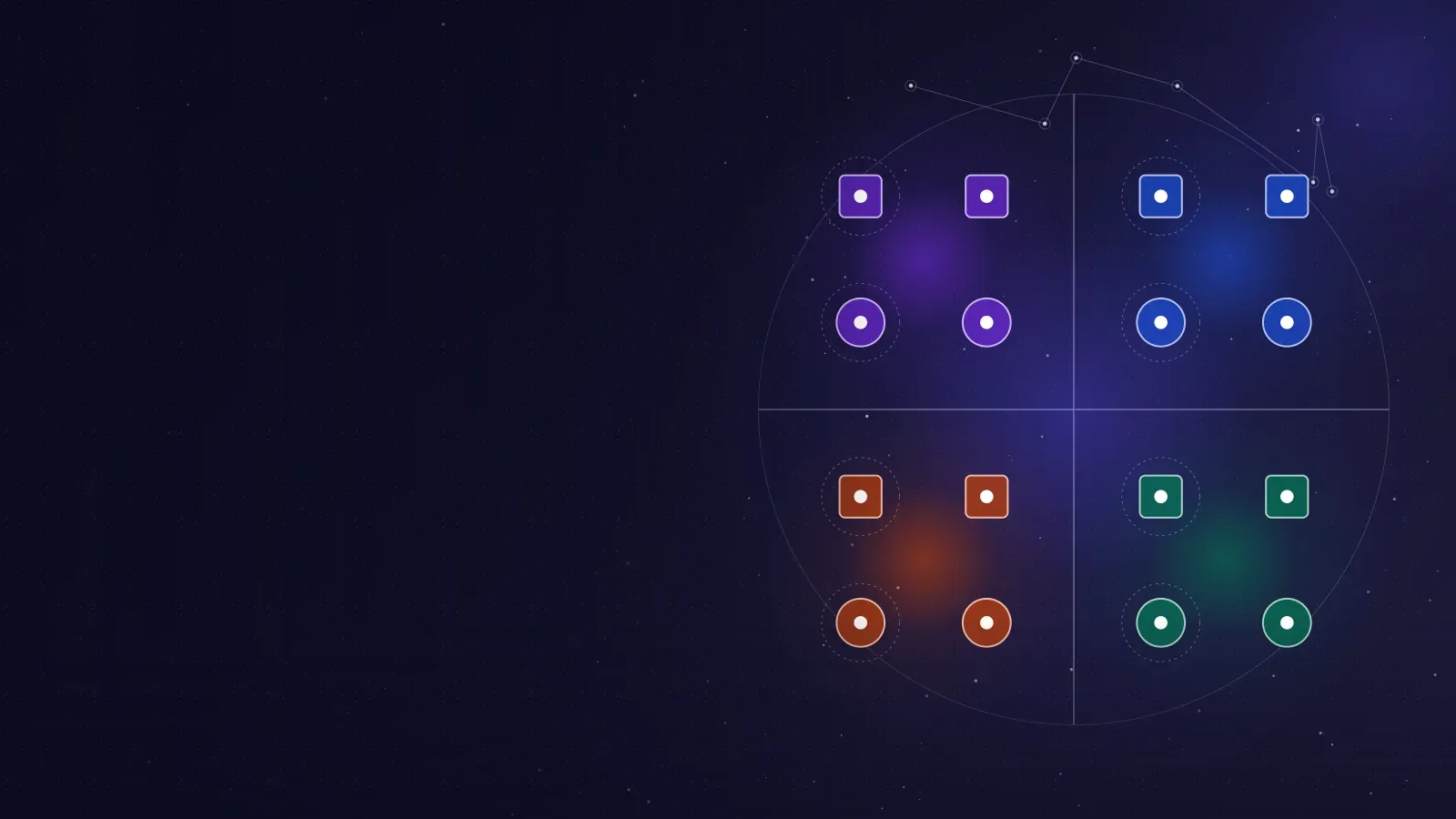
The four color groups match the first two axes: HE (purple), HR (blue), DE (coral pink), DR (green). Each type has its own strengths and growth areas; no type is "better" than another. You can browse them all on the 16 types page.
Limitations of the model
- Not a diagnostic tool. Results do not replace an in-person assessment by a psychologist and must not be used to diagnose any psychological or medical condition.
- Limited reference group. Norm tables are built separately for each test version and are not a nationally representative sample. Your index shows your relative position within this reference group, not an absolute score.
- The EQ side relies on self-report. Answers can be influenced by mood or by the wish to give the "right" answer.
- Classification loses information. Sorting people into 16 types makes results easier to grasp but ignores continuity: someone with an IQ of 109 and someone with 111 are very similar even though their letters differ. Look at the 10-ability chart, not just the type code.
- Results can change. Abilities develop with time, learning and experience; today's result is a snapshot of one moment.
- The model is still being refined. Questions and norm tables will continue to be reviewed, validated and updated.
In short: use your IEQ result as a mirror to understand yourself and to find directions for growth, not as a verdict or a permanent label.
References
- Carroll, J. B. (1993). Human Cognitive Abilities: A Survey of Factor-Analytic Studies. Cambridge University Press.
- McGrew, K. S. (2009). CHC theory and the human cognitive abilities project: Standing on the shoulders of the giants of psychometric intelligence research. Intelligence, 37(1), 1–10.
- Salovey, P., & Mayer, J. D. (1990). Emotional intelligence. Imagination, Cognition and Personality, 9(3), 185–211.
- Mayer, J. D., & Salovey, P. (1997). What is emotional intelligence? In P. Salovey & D. Sluyter (Eds.), Emotional Development and Emotional Intelligence: Educational Implications (pp. 3–31). Basic Books.
- Goleman, D. (1995). Emotional Intelligence: Why It Can Matter More Than IQ. Bantam Books.
- Mayer, J. D., Caruso, D. R., & Salovey, P. (2016). The ability model of emotional intelligence: Principles and updates. Emotion Review, 8(4), 290–300.